KAWASAKI G4TR-A Frame Chassis 100CC
fits model: G4tr, Trail, Boss. make: Kawasaki. year: 1970.
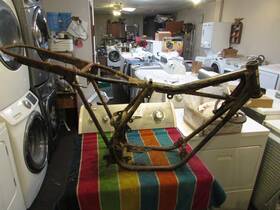
( Manufacturer Part Number: G4TR-A ), ( Model: G4TR-A 100 TRAIL BOSS ), ( Sub-type: Frames ), ( Type: Frame ), ( Intended Use: Replacement Part ), ( Vintage Part: Yes ), ( Country Of Origin: Japan )
Review KAWASAKI 100cc Frame Chassis fits TRAIL BOSS G4TR 1970
The **1970 Kawasaki G4TR-A Trail Boss**, a legendary trail bike from the golden era of Japanese motorcycle engineering, stands as a testament to Kawasaki s early innovations and the spirit of off-road adventure. This rare and highly sought-after machine is a refined evolution of the original G4TR, designed specifically for rugged terrain and long-distance touring with a blend of trail-bike agility and lightweight efficiency. Built around a **100cc air-cooled single-cylinder engine**, the G4TR-A s powerplant is a masterpiece of simplicity and durability, featuring a smooth-running overhead valve (OHV) design with a single carburetor for precise throttle response. The engine s compact yet robust construction, paired with a lightweight aluminum frame and a sturdy **dual-cradle chassis**, delivers an ideal balance of maneuverability and stability perfect for navigating rocky trails, steep climbs, and winding forest paths. The Trail Boss designation hints at its intended use as a versatile off-road companion, yet its elegant lines and classic styling make it equally at home on paved roads.
The **frame and chassis** of the 1970 G4TR-A are a study in functional minimalism, with a **steel double-cradle design** that prioritizes rigidity and weight savings. The bike s **girder fork front end** and **swingarm rear suspension** offer a firm yet compliant ride, allowing the rider to absorb the bumps of rough terrain while maintaining precise control. The **single-disc front brake** (a rarity for its time) and simple drum brake at the rear ensure reliable stopping power without the complexity of modern hydraulic systems. The bike s **steel trellis frame** is not only lightweight but also designed to absorb shocks, reducing fatigue on long rides. The **aluminum fuel tank** and **chrome-plated components** add to its classic aesthetic, while the **spoked wheels** with durable tires provide both grip and durability on varied surfaces.
Crafted for both performance and practicality, the G4TR-A features a **top-box storage compartment** behind the seat, offering a practical solution for carrying essentials on extended trips. The **adjustable handlebars** and **upright riding position** make it comfortable for long hours in the saddle, whether tackling a mountain trail or cruising along a scenic backroad. The bike s **manual transmission** with a smooth-shifting three-speed gearbox ensures effortless control, while the **kick-start mechanism** (a nod to the era s practicality) adds to its vintage charm. Though the engine s 100cc displacement may seem modest by today s standards, the G4TR-A s true strength lies in its **lightweight agility, reliability, and timeless design** qualities that make it a favorite among collectors and enthusiasts who appreciate the raw, unfiltered spirit of early Japanese motorcycling.
With its **limited production numbers** and enduring appeal, the 1970 Kawasaki G4TR-A Trail Boss is not just a motorcycle it s a piece of automotive history. Whether restored to showroom condition or preserved in its original patina, this bike embodies the adventurous ethos of its era, offering riders a chance to experience the thrill of trail riding with a machine that is as much a work of art as it is a functional tool. For those who seek a blend of nostalgia, performance, and rugged capability, the G4TR-A stands as a true icon of the golden age of motorcycling.
The **1970 Kawasaki G4TR-A (100cc Trail Boss frame/chassis)** is a rare and highly sought-after classic motorcycle, particularly among enthusiasts of Japanese trail bikes and early Kawasaki models. Below is a detailed breakdown of its pros and cons, followed by a conclusion and recommendation.
---
### **Pros**
1. **Historical Significance and Rarity**
The G4TR-A is one of the earliest production trail bikes from Kawasaki, introduced in 1969 as a more rugged alternative to the G4TR (which was primarily a sport-touring bike). The Trail Boss variant featured a reinforced frame and chassis designed for off-road use, making it a precursor to Kawasaki s later trail and enduro models. Its scarcity especially in original condition adds to its appeal for collectors and historians.
2. **Classic Japanese Engineering**
Kawasaki s early 100cc air-cooled single-cylinder engines were known for their simplicity, durability, and smooth operation. The G4TR-A s engine is a reliable unit, often praised for its straightforward design and ease of maintenance. The bike s mechanical components, such as the chain drive, drum brakes, and basic suspension, reflect the engineering of the era, which many riders appreciate for its authenticity.
3. **Off-Road Capability**
The Trail Boss frame was specifically designed for trail riding, with a slightly longer wheelbase and reinforced construction compared to the standard G4TR. This makes it more stable on rough terrain, though it is not as capable as modern enduro bikes. The bike s lightweight and nimble handling also make it suitable for light off-road adventures, particularly on gravel roads or trails.
4. **Aesthetic Appeal**
The G4TR-A s design is iconic for its time, with a clean, angular look that harks back to the early 1970s. The black and chrome finish, along with its compact size, gives it a timeless, retro charm. Many riders enjoy the bike s understated elegance and its place in Kawasaki s evolution from simple utility bikes to more specialized models.
5. **Potential for Restoration or Modification**
Because the G4TR-A is not mass-produced today, parts can be challenging to find, but its simplicity makes it a manageable project for skilled mechanics or DIY enthusiasts. Restoration projects can be rewarding, and modifications such as upgrading the suspension, brakes, or exhaust can enhance its performance without compromising its vintage character.
6. **Low Operating Costs**
Fuel efficiency is excellent for a 100cc bike, and maintenance costs are minimal compared to modern motorcycles. The lack of complex electronics or advanced components means fewer things can go wrong, and spare parts (where available) are often inexpensive.
7. **Community and Nostalgia**
Owning a G4TR-A grants access to a niche community of classic bike enthusiasts who share a passion for Japanese trail bikes from the 1960s and 1970s. This can lead to camaraderie, shared knowledge, and even opportunities to participate in vintage bike rallies or meets.
---
### **Cons**
1. **Extreme Rarity and High Cost**
The G4TR-A is one of the rarest Kawasaki models from this era, and original examples especially those in good condition can command prices well above $10,000 or more, depending on provenance, restoration status, and market demand. This makes it a significant financial investment with limited liquidity.
2. **Limited Availability of Parts**
While Kawasaki produced many bikes in the 1960s and 1970s, the G4TR-A was not a high-volume model. Finding original parts, such as the engine, frame, or suspension components, can be difficult. Replacement parts may require sourcing from collectors, salvage yards, or overseas suppliers, which can be time-consuming and costly.
3. **Outdated Safety and Comfort Features**
The G4TR-A lacks modern safety features such as ABS, traction control, or advanced braking systems. The drum brakes are not as effective as disc brakes, and the suspension is basic, offering little comfort on rough roads or long rides. The lack of wind protection and ergonomic considerations also makes it less suitable for highway riding or extended tours.
4. **Performance Limitations**
The 100cc air-cooled single-cylinder engine is powerful enough for light trail riding but lacks the torque and power for aggressive off-road use or highway speeds. The bike s top speed is modest (around 50-60 mph), and acceleration is sluggish compared to modern bikes. The manual transmission and chain drive are efficient but not as refined as modern alternatives.
5. **Maintenance Challenges**
While the bike is simple, its age means that some components may be worn or degraded over time. Rust, worn bearings, and aging rubber parts (such as the tires or suspension seals) are common issues that require regular attention. Without proper maintenance, the bike can become unreliable or unsafe.
6. **Legal and Insurance Considerations**
Many jurisdictions have strict regulations on vintage bikes, particularly those without modern safety equipment. Insurance for a classic bike can be expensive, and registration or homologation may require additional paperwork or modifications to meet contemporary standards.
7. **Limited Practical Use**
The G4TR-A is not a versatile bike. It is best suited for casual trail riding, commuting on quiet roads, or as a collector s item. It is not practical for daily use in heavy traffic, long-distance touring, or serious off-road adventures without significant modifications.
8. **Environmental and Noise Regulations**
Older bikes often fail modern emissions and noise standards, which can lead to restrictions on where and how they can be ridden. Some areas may require mufflers or other modifications to comply with local laws, adding to the cost and complexity of ownership.
---
### **Conclusion**
The **1970 Kawasaki G4TR-A Trail Boss** is a fascinating piece of motorcycle history with a devoted following among collectors and enthusiasts of classic Japanese bikes. Its strengths lie in its rarity, historical significance, off-road capability, and the satisfaction of owning a well-preserved piece of the past. However, its extreme rarity, high cost, limited practicality, and challenges in maintenance and part sourcing make it a niche acquisition rather than a practical daily rider.
For the right buyer someone who appreciates vintage motorcycles, enjoys restoration projects, or seeks a unique conversation piece the G4TR-A can be an incredibly rewarding purchase. For most riders, however, the bike s limitations in performance, safety, and modern usability make it less ideal as a primary motorcycle. It is best suited for those who prioritize heritage and nostalgia over functionality.
---
### **Recommendation**
- **Buy if:** You are a collector with a deep appreciation for classic Japanese motorcycles, have the financial means to invest in a rare bike, and are willing to commit to maintenance, restoration, or modifications. You also enjoy the challenge of owning a bike with historical significance and are prepared to ride it in a controlled, practical manner (e.g., light trail riding or commuting on quiet roads).
- **Avoid if:** You need a reliable, modern, or versatile motorcycle for daily use, highway riding, or serious off-road adventures. If you prioritize safety features, comfort, or practicality over vintage charm, consider a more contemporary trail bike or a restored classic that offers better balance between heritage and usability.
- **Alternative Considerations:** If you love the G4TR-A s era but want something more practical, look for other Kawasaki trail bikes from the 1970s, such as the **G4TR (1969-1971)**, **G5TR (1972-1973)**, or **A1 (1970s)**, which are slightly more common and offer better balance between trail capability and road usability. For a modern trail bike with classic inspiration, consider a **Kawasaki KLX230S** or **KLR650**, which retain some of the spirit of early trail bikes while offering contemporary features.
Ultimately, the G4TR-A is a bike for enthusiasts, not general riders. Its value lies in its story and its place in Kawasaki s legacy, not in its modern-day practicality.
Details:
Designed for the adventure-loving rider, this frame is a testament to Kawasaki's enduring commitment off-road excellence. Perfect for the restoration enthusiast or as a replacement part, this vintage frame is crafted to fit G4TR-A 100 Trail Boss model. As a genuine Kawasaki part, it ensures compatibility and maintains the integrity of your motorcycle.
part #: g4tr prices
- $31.45-$235.00
specifications mocycfra:
- for models: G4tr, Trail, Boss
- for makes: Kawasaki
- for years: 1970
- mpn: G4tr-a
- model: G4tr-a 100 Trail Boss
- sub-type: Frames
- type: Frame
- intended use: Replacement Part
- vintage part: Yes
- country of origin: Japan
payments mocycfra:
- other
- wallet: Apple-pay
- credit card: Diners-club
returns mocycfra:
- paid by: Buyer
- policy: Returns Accepted
- time: 30 Days
offer mocycfra:
- availability: In Stock
- best offers: True
- options: Ship-to-home
- quantity: 1
- sold: 0
- started: March 18, 2026
shipping mocycfra:
- cost: $75.00
- service: USPS Ground Advantage
- type: Fixed
- class: Standard
- transit: 4-10 Days
- carrier: USPS
general mocycfra:
- condition: Used
- Motorcycle Scooter Parts Accessories > Body Frame > Frames Parts
seller mocycfra:
- city: Clayton, Indiana
- # reviews: 914
- rating: 98.4%
Kawasaki G4TR Is Similar To:
- 0121 Shogun Motorsports No Cut Frame Slider Protector For Kawasaki Zx (14.4% similar) Shogun frame sliders kawasaki ZX-10R 2006 -2007THE slider features CBC-machined pucks made of a shatter-proof, abrasion-resistant and UV resistant polymer. Shogun frame sliders are designed by racers, sold for the serious rider. This polymer has been race proven to keep your bike sliding and ...(March 30th, 2019)
- 034-00460 Lightspeed Carbon Frame Guard Set Fiber For Kawasaki (13.6% similar) ...(October 24th, 2018)
- 034-00490 Lightspeed Carbon Frame Guard Set Fiber For Kawasaki (13.6% similar) ...(July 16th, 2018)
- 04-00917-02 Powerstands Black Kawasaki Powersports Racing Frame Sliders (33.1% similar) Shipping available to USA only. Shipping requires a street address...(October 26th, 2018)
- 040bg146410 Yoshimura Works Frame Sliders Kawasaki Protector New (23.3% similar) Brand new never opened...(June 20th, 2018)
- 040bg147000 Yoshimura Chassis Protector Kit Kawasaki (35.2% similar) Brand new in box...(February 25th, 2017)
- 040ha146410 Yoshimura Works Edition Frame Sliders Kawasaki Ninja (18.3% similar) Help minimize damage from sliding type FALLS6061-T6 aluminum mounts are CBC machined and hard-anodize dinner sleeve with laser-etched Chimera logo includes all required mounting hardware stainless steel bolts sold as pairs note: no fairing modifications. The plastic construction is soft enough to ...(July 5th, 2018)
- 0906884 Kawasaki Ninja Rear Subframe Back Sub Frame Bracket Mount (41.3% similar) Each part is systematically placed to be easily located once purchased. More options available upon request. Many countries only allow 79 max package length and girth combined...(April 11th, 2018)
- 0906885 Kawasaki Ninja Rear Subframe Back Sub Frame (43% similar) More options available upon request. Many countries only allow 79 max package length and girth combined. Each part is systematically placed to be easily located once purchased. If the item does not fit motorcycle model's specified in listing...(April 11th, 2018)
- 1051554 Kawasaki 2017 Er-650hframe Chassis (49% similar) Each part is systematically placed to be easily located once purchased. More options available upon request. Many countries only allow 79 max package length and girth combined. If the item does not fit motorcycle model's specified in listing...(February 15th, 2018)
- 1064301 Kawasaki Ninja Frame Chassis Slvg (49.5% similar) More options available upon request. Many countries only allow 79 max package length and girth combined. Each part is systematically placed to be easily located once purchased. If the item does not fit motorcycle model's specified in listing...(May 23rd, 2018)